IFR Written Test Prep Frontal Waves Normally Form On YouTube
Web Frontal waves normally form on a slow moving cold fronts or stationary fronts b slow moving warm fronts and strong occluded fronts c rapidly moving cold
Frontal Wave Encyclopedia, Web May 8 2018 nbsp 0183 32 frontal wave A wave like deformation of the line of a front between two air masses The wave develops from the northward incursion of warm air and usually travels along the front with colder air ahead and to the rear

Fronts Aviation Weather
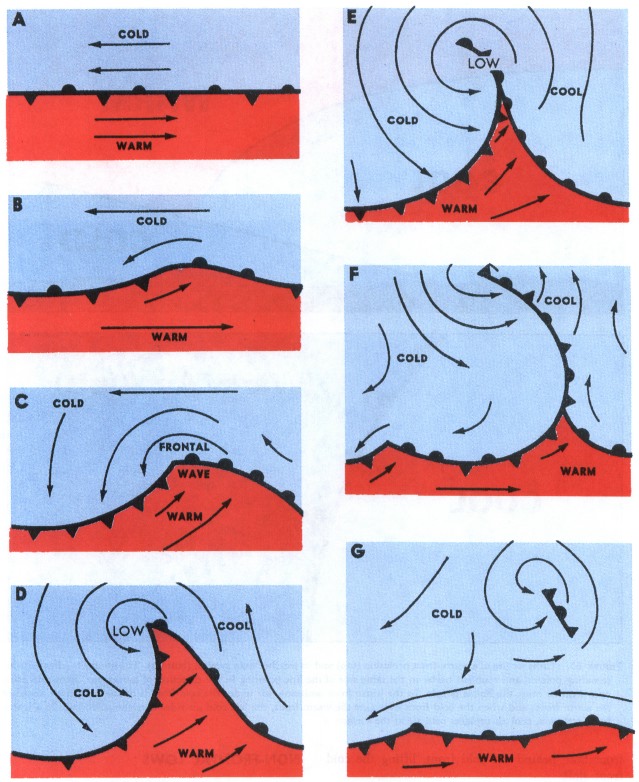
Web Frontal waves and cyclones areas of low pressure usually form on slow moving cold fronts or on stationary fronts The life cycle and movement of a cyclone is dictated to a great extent by the upper wind flow In the initial condition of frontal wave development in figure 62 the winds on both sides of the front are blowing parallel to the
Frontal Waves Weather And Climate Brian Williams, Web Jan 13 2023 nbsp 0183 32 Frontal waves form when two air masses of different temperatures meet creating an area of instability The air masses must have a considerable difference in temperature humidity and or pressure they must also

Air Mass Types Met Office
Air Mass Types Met Office, Web A waving front or frontal wave is a disturbance that runs along a cold front and slows its clearance often bringing a longer period of wet weather

40 Frontal Waves Stock Photos Pictures Royalty Free Images IStock
Extratropical Cyclone Wikipedia
Extratropical Cyclone Wikipedia Web Extratropical cyclones are classified mainly as baroclinic because they form along zones of temperature and dewpoint gradient known as frontal zones They can become barotropic late in their life cycle when the distribution of heat around the cyclone becomes fairly uniform with its radius
Loose Wave Frontal Unit Loose Waves Frontal Style
Web Types of Surface Fronts amp Their Characteristics Watch on Terminology An air mass is a large body of air with similar horizontal temperature and moisture density characteristics Skew T soundings throughout the air mass will be similar A transition zone frontal zone is a region of large horizontal temperature contrast between two air masses Frontal Systems amp Types Of Fronts Found On Weather Charts. Web Oct 4 2022 nbsp 0183 32 Frontal waves normally form on slow moving cold fronts or stationary fronts Squall lines most often appear ahead of a cold front With a warm front the most critical period for wind shear is before the front passes the airport Web In which meteorological conditions can frontal waves and low pressure areas form A Warm fronts and occluded fronts B Slow moving cold fronts or stationary fronts

Another Frontal Waves Normally Form On you can download
You can find and download another posts related to Frontal Waves Normally Form On by clicking link below
- An Airborne And Ground Based Study Of A Long Lived And Intense
- WhatsApp 86 180 5350 3095 Lace Frontal With Bundlesdeep Wave Wholesale
- Frontal Frontal Deep Wave Waves
- Brazilian Body Wave Frontal UPSCALEHAIR
- The Two Types Of Frontal Waves indicated By Arrows In A Premature
Thankyou for visiting and read this post about Frontal Waves Normally Form On